“I read the other day about these bio-hackers who are injecting their
eyeballs with some bioluminescent fluid that gives them night vision –
it’s crazy.”
Dan Bunting, lead multiplayer designer at Treyarch, is talking about
the news stories that have influenced Black Ops 3 during the game’s
three-year development cycle. Set 50 years in the future, with a new
Cold War as its backdrop, the latest CoD battlefield is a very different
place. Widescale Drone warfare has been neutralised through the
development of powerful air defence systems, so the emphasis is back on
ground infantry once again.
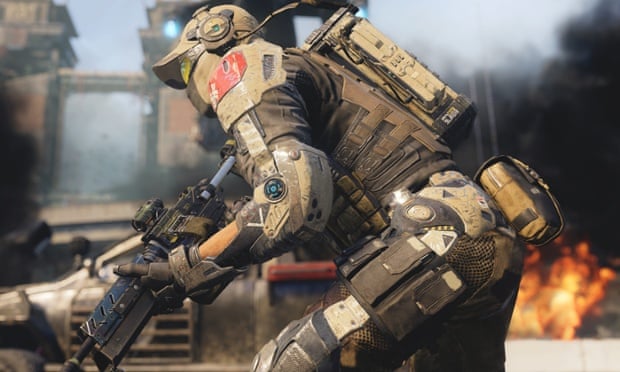
But the soldiers themselves have changed. The invention of direct
neural interfacing between the human brain and computer technology has
led to a new era of bio-augmentation and cybernetic enhancement. In
Black Ops 3, the player is part of an experimental unit fitted with
bionic limbs and a wealth of other future-tech improvements that blend
mind and machine. According to Treyarch a lot of this is closer to
science than fiction.
“You make an estimate of where you think technology will be in the
2060s, then a few months later you hear that the foundations of that
technology are happening today,” says camp
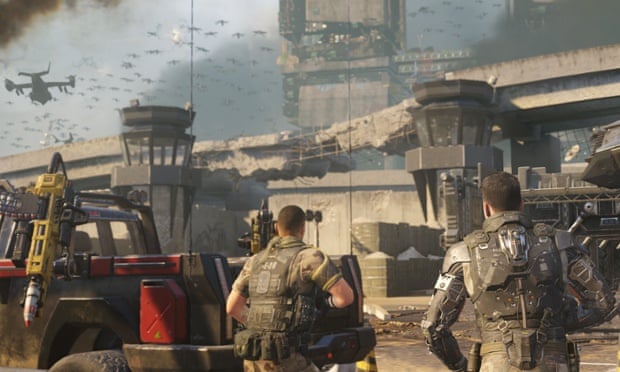
During a press visit to the Treyarch studio in Santa Monica, the team
shows off a demo of one Black Ops 3 campaign mission, which takes place
at Cairo’s Ramses station. It’s pretty recognisable
Call of Duty
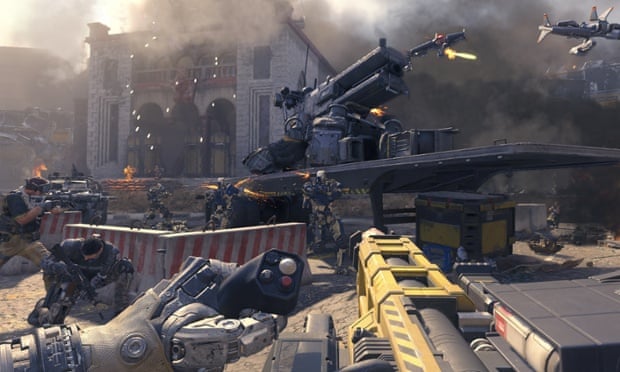
fare, a chaotic maelstrom of swarming ground troops, explosive air
support and yelling NPCs. However, the high-tech stuff soon arrives. A
dropship deposits a self-building “mobile wall” into the street to
cordon off the area. Later, the player’s squad is attacked by a duo of
giant robotic balls covered in spikes that zoom in and splatter their
way through the forces (these devastating gadgets – weirdly reminiscent
of the alien weaponry in the Battleships movie – are called Robotic
Anti-Personnel Sentry Droids, and are available as a scorestreak in the
multiplayer). Then, a cloud of mini-drones immolate a soldier. The scene
ends with one allied operative using a tablet to select a whole area of
the battlefield before seemingly causing it to blow apart through
cybernetically-enhanced telekinesis.
In
gameplay terms, the most obvious impact of this technological leap into
bio-augmentation is the new movement system. Player soldiers wear
upgradeable cyber-suits that allow them to double jump onto rooftops,
run along walls and powerslide along the floor, chaining moves together
to traverse the environment in a smooth, streamlined dance. Objects can
be mantled without loss of speed or firing potential and soldiers can
sprint
forever: “There is no marathon perk, there is no
lightweight perk, it just works that way,” says studio design director
David Vonderhaar. “This is really important. It’s the glue that holds
everything else together. You can continue to stay guns-up. The aim is
to wind the combat loop as tight as possible.”
Of course, comparisons with both Call of Duty: Advanced Warfare and
rival sci-fi shooter Titanfall are inevitable. The latter made a big
deal of its enhanced boost jumps and vertical sprinting, and given the
fact that developer Respawn Entertainment emerged from Call of Duty
creator Infinity Ward in the most controversial of circumstances,
criticisms and conspiracy theories are going to cloud this aspect of the
game.
And they won’t finish there. The new “specialists” feature in Black
Ops 3 allows players to take part in multiplayer bouts as one of nine
elite spec-ops warriors, each with their own powerful special weapons
and abilities. These are only available when an onscreen meter powers
up, and they are intended as a mid-point between regular combat and the
scorestreaks that tend only to be accessible to more skilled players. It
all sounds extremely similar to the Titan system in Respawn’s game,
where a timer counts down to the point at which players get to call in
their giant mech.
Naturally, Treyarch doesn’t broach this directly – but it does
address questions about how familiar the system seems. “It’s not to be
confused with the [Advanced Warfare] exo jump; mechanically, it works
extremely differently,” says Vonderhaar. “Ours has nothing to do with
verticality – our maps have a height limit of two storeys and staying in
the combat frame [i.e. being able to always see the opponent] are keys
to our design strategy. But we did want to remove the obstacles that
slow the player down. Ladders in [multiplayer] suck. They’re not fun to
get on and climb up.”
Then studio head Mark Lamia chimes in with a comment seemingly laser targeted at any Titanfall references. “To be fair, we
did
make Spider-Man,” he says, referring to the company’s acclaimed,
parkour-influenced super hero tie-in from 2002. “We had some amazing
movement systems in that game. We showed Black Ops 3 to the Tony Hawk’s
Pro Skater developers and said ‘you guys should get this’. And they
did.”
At the demo event, we get to play three new multiplayer maps. Combine
is set in a labyrinthine farming research facility in the Egyptian
Sahara, with an open courtyard providing a frenetic kill zone in the
centre. Stronghold is a Swiss chateau which mixes tight interiors with
open areas that offer long sight lines. Hunted is the biggest map in the
game, a picturesque mansion complete with a waterfall, pool and
underwater tunnel.
It’s the latter that proves most interesting. Treyarch has apparently
been trying to add swimming to its CoD games for years, but has finally
mastered the feature. Now you can dive into the water, move about
freely in the aquatic environment, and even use your gun. A pre-demo
video shows players shooting out of the water at passersby moving along
the water’s edge.
Elsewhere, the movement system does handle very differently to
Advanced Warfare. The controls are more subtle, so that it feels less
like a turbo boost into the air, and more like a controlled ascent. Wall
runs are easy to set up via an angled sprint toward a vertical surface
and a deft tap on the jump button. When connected with a wall, you can
then leap on to another surface, and even jump out, pull back on the
analogue stick and reverse the movement, so you’re suddenly going
backwards. It’s a great evasive move, and it suggests that head-to-head
encounters are going to be less about who has the fastest trigger
finger.
Jump out again, then press the “crouch” button and you hit the ground
in a power slide, which can be directed around corners. It’s complex
yet accessible and within minutes players are chaining moves together,
turning the environment into a pro-skater playground. We’re having a lot
of fun.
But we’re also aware that this is not unique and it’s not, in itself,
innovative: rocket jumps and special ability pick-ups have been part of
first-person shooter design since the beginning. Before CoD, before
Titanfall, id Software littered its levels with limited availability
weapons and armour; Crysis brought us cyber suits and timed abilities.
This has always been a genre that has supported the evolution and
sub-division of feature-sets. But Treyarch is going to have to be on the
defensive. And it will need to reassure gamers who prefer the
traditional CoD experience that its flights of spatial fancy won’t be
too disruptive. “We don’t force anything on players,” says Bunting. “If
they don’t want to use thrust jump or wall-running they don’t have to.
Most encounters will still be boots-on-the floor.”

Really though, perhaps the biggest change to Call of Duty is
happening away from multiplayer, and away from movement controls. It is
the campaign mission design. Not only will this mode be playable in
co-op with up to three friends, but Treyarch says that the game will
abandon the corridor approach and provide much larger, more explorable
environments. “We’re allowing you to go off the rails,” says Blundell.
“You will really be able to explore the space, to decide how you engage
the area and to move through it.”
Apparently, the areas are so open that players simply won’t be able
to see everything in one playthrough – if they choose an approach, there
will be sections they won’t see. Also, in classic RPG style, players
will be able to upgrade their characters with a range of special
abilities as they gain XP. These aren’t the static pre-set soldiers of
traditional CoD, these are personalised avatars who progress. According
to Treyarch there are around 40 “cyber core” abilities, like drone
hacking for example, that players earn as they go and can use when they
like. And as players gain new abilities they get to show these off in
the dedicated safe house area visited between missions, where soldiers
are customised and where participants can personalise their bunks with
medals and achievement markers.
Blundell says this concept of freeform character customisation has
forced changes to the narrative structure. Black Ops 2 brought in
branching story elements with several different endings. Black Ops 3
gains longevity in a different way. “Due to the type of game it is, and
the type of story we wanted to tell, rather than having a branching
storyline, we’ve gone for a design that’s more like peeling back layers
of an onion – that’s the most tactical way I can describe it,” explains
Blundell. “This is definitely a story that needs multiple replays; there
are different perspectives, things that you learn as you play, so you
may want to go back later to re-experience certain moments in a fresh
way.”
Treyarch also reckons that this move to open environments and
customisable player-characters has demanded major changes to the
artificial intelligence system too. “As the spaces get bigger, the AI
needs to be able to make intelligent decisions in that space,” says
Blundell. “So we’ve created a new animation system and a goal-orientated
AI that supports over 20 different types of archetypes – bipedal
robots, humans, rolling balls of death – they decide how they engage you
and how they move through space. For the first time they also
communicate together and move into formations based on where you are and
your abilities.”
Once again, it’s nothing new for the genre, but it’s certainly new
for Call of Duty. True, this is still a game about shooting people in
the face, and the setup remains a macho fantasy of specialist warriors
going in and clearing up when science and military-industrial complexes
drop the fucking ball, dude. But the Black Ops series has always toyed
with the fundaments of the series, and this is an interesting step
toward something slightly more complicated. The role-playing elements,
the reactive AI and the slick traversal systems represent a climb out of
CoD’s self-imposed ghetto of immediate, gutsy action and twitch-core
simplicity.
So while non-believers will wince and hurl accusations, long-term
fans will be intrigued. Call of Duty, always the totem of unapologetic
blast-em-up action, is also sometimes a subversive presence – witness
the legendary nuclear death scene in Modern Warfare or the
stomach-churning No Russian mission in Modern Warfare 2. Treyarch is
promising a gritty messed-up story with Black Ops 3, and it says it has
big plans for the Zombie mode (which is set to have its own dedicated XP
progression system) but it’s the systemic changes that could prove most
interesting and disruptive to this vast money-making edifice.
“In game development, if you feel totally comfortable you’re not
doing it right,” says Bunting. “This is our first time on the new
console technology, we’ve had a three-year cycle, so we took bigger
risks from the outset. We wanted to go for something new and fresh.”
I guess we’re about to find out what new and fresh looks like when there’s a billion dollars riding on the result.
@http://www.theguardian.com/technology/2015/apr/28/call-of-duty-black-ops-3-biggest-shooter-in-world




.jpg)


